開催日時 & 会場
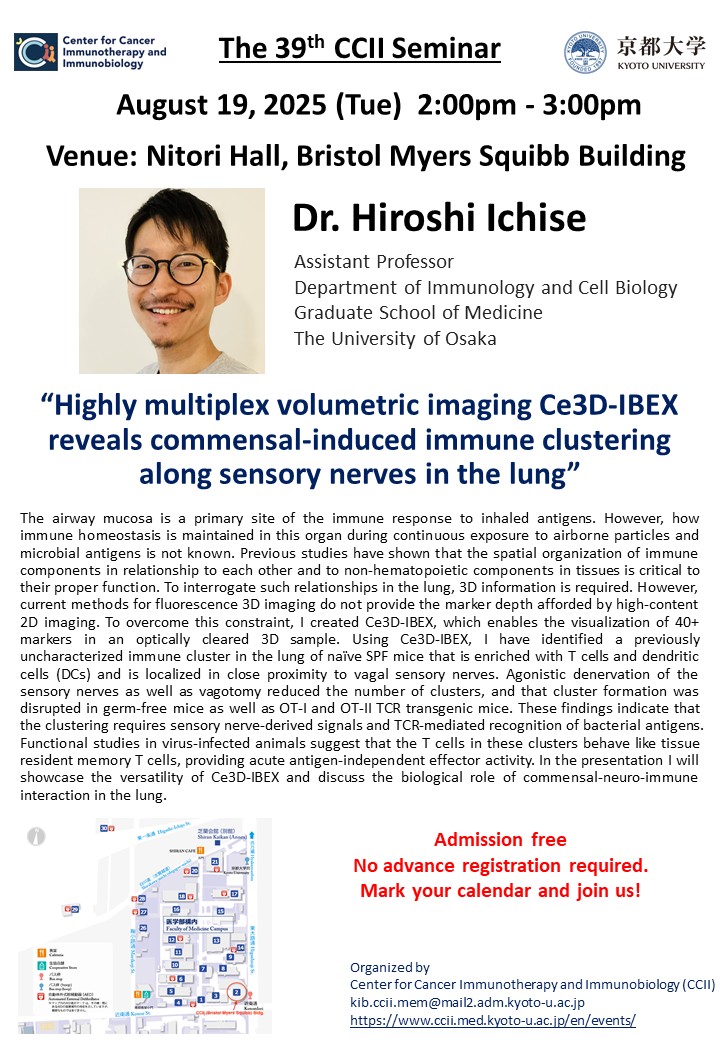
- 2025年8月19日(火) 2:00pm – 3:00pm
- 会場: NITORI HALL, Bristol Myers Squibb Building 1F
- 対面型/参加無料(事前登録不要)
- 主催者 : がん免疫総合研究センター (CCII)
演者

Dr. Hiroshi Ichise
Assistant Professor
Department of Immunology and Cell Biology
Graduate School of Medicine
The University of Osaka
概要
The airway mucosa is a primary site of the immune response to inhaled antigens. However, how immune homeostasis is maintained in this organ during continuous exposure to airborne particles and microbial antigens is not known. Previous studies have shown that the spatial organization of immune components in relationship to each other and to non-hematopoietic components in tissues is critical to their proper function. To interrogate such relationships in the lung, 3D information is required. However, current methods for fluorescence 3D imaging do not provide the marker depth afforded by high-content 2D imaging. To overcome this constraint, I created Ce3D-IBEX, which enables the visualization of 40+ markers in an optically cleared 3D sample. Using Ce3D-IBEX, I have identified a previously uncharacterized immune cluster in the lung of naïve SPF mice that is enriched with T cells and dendritic cells (DCs) and is localized in close proximity to vagal sensory nerves. Agonistic denervation of the sensory nerves as well as vagotomy reduced the number of clusters, and that cluster formation was disrupted in germ-free mice as well as OT-I and OT-II TCR transgenic mice. These findings indicate that the clustering requires sensory nerve-derived signals and TCR-mediated recognition of bacterial antigens. Functional studies in virus-infected animals suggest that the T cells in these clusters behave like tissue resident memory T cells, providing acute antigen-independent effector activity. In the presentation I will showcase the versatility of Ce3D-IBEX and discuss the biological role of commensal-neuro-immune interaction in the lung.
ポスター